On the Trail of Our History
We took our 120th anniversary in 2015 as an opportunity to go on a search for traces. Due to the extensive destruction during the Second World War, many documents and photos were unfortunately destroyed, so we were only able to piece together our history piecemeal. Hours of searching for clues in the City Museum and City Archives shed some light on the darkness. A few old newspaper articles filled in the gaps. Unfortunately, we will never be able to fully reconstruct our history. But what we have discovered testifies to a fascinating story that we would like to share with you.
The Early Years of the Kaiserhof
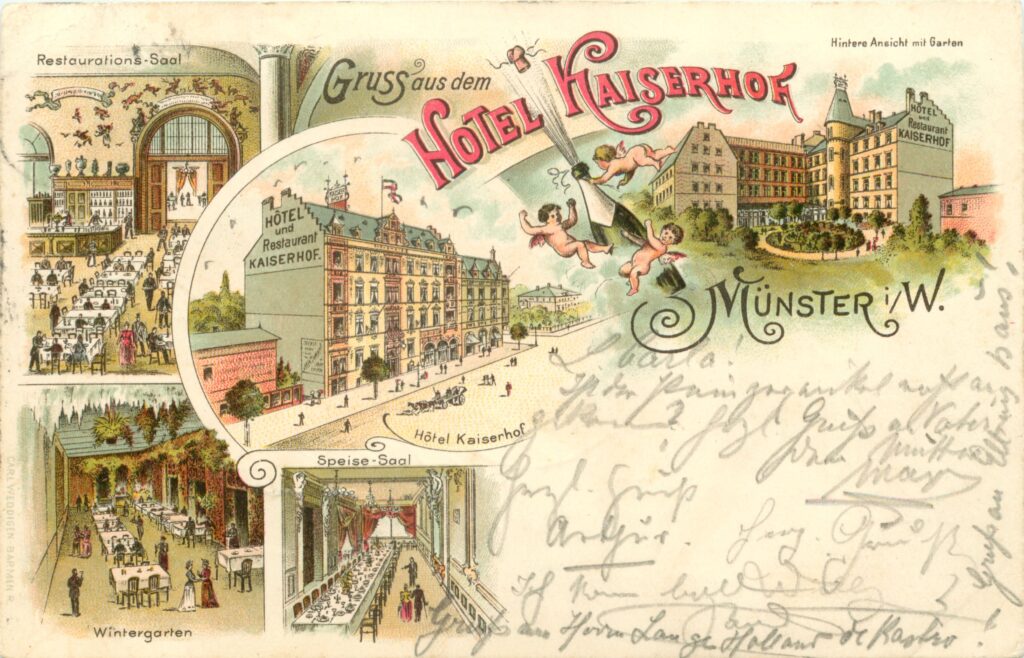
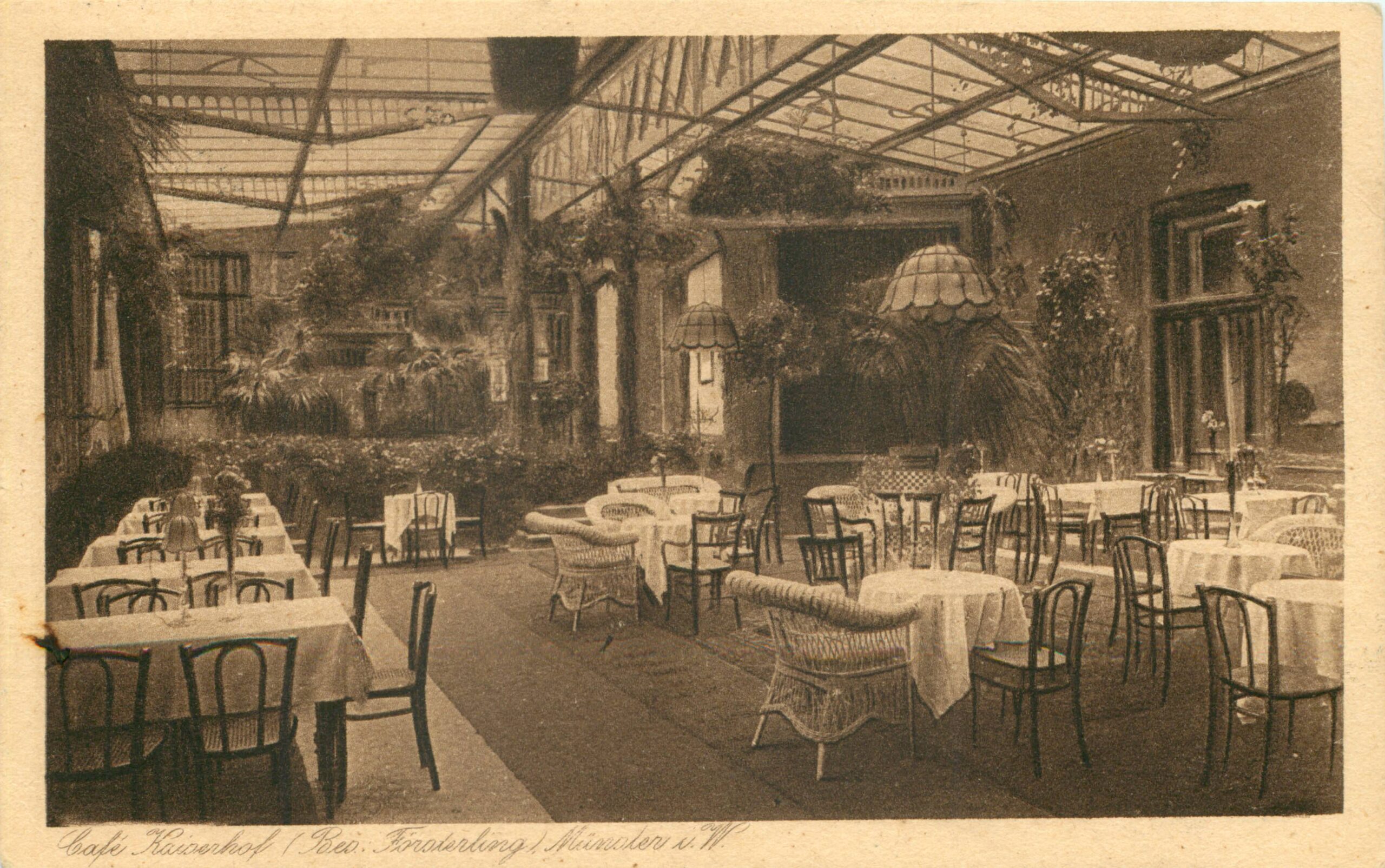
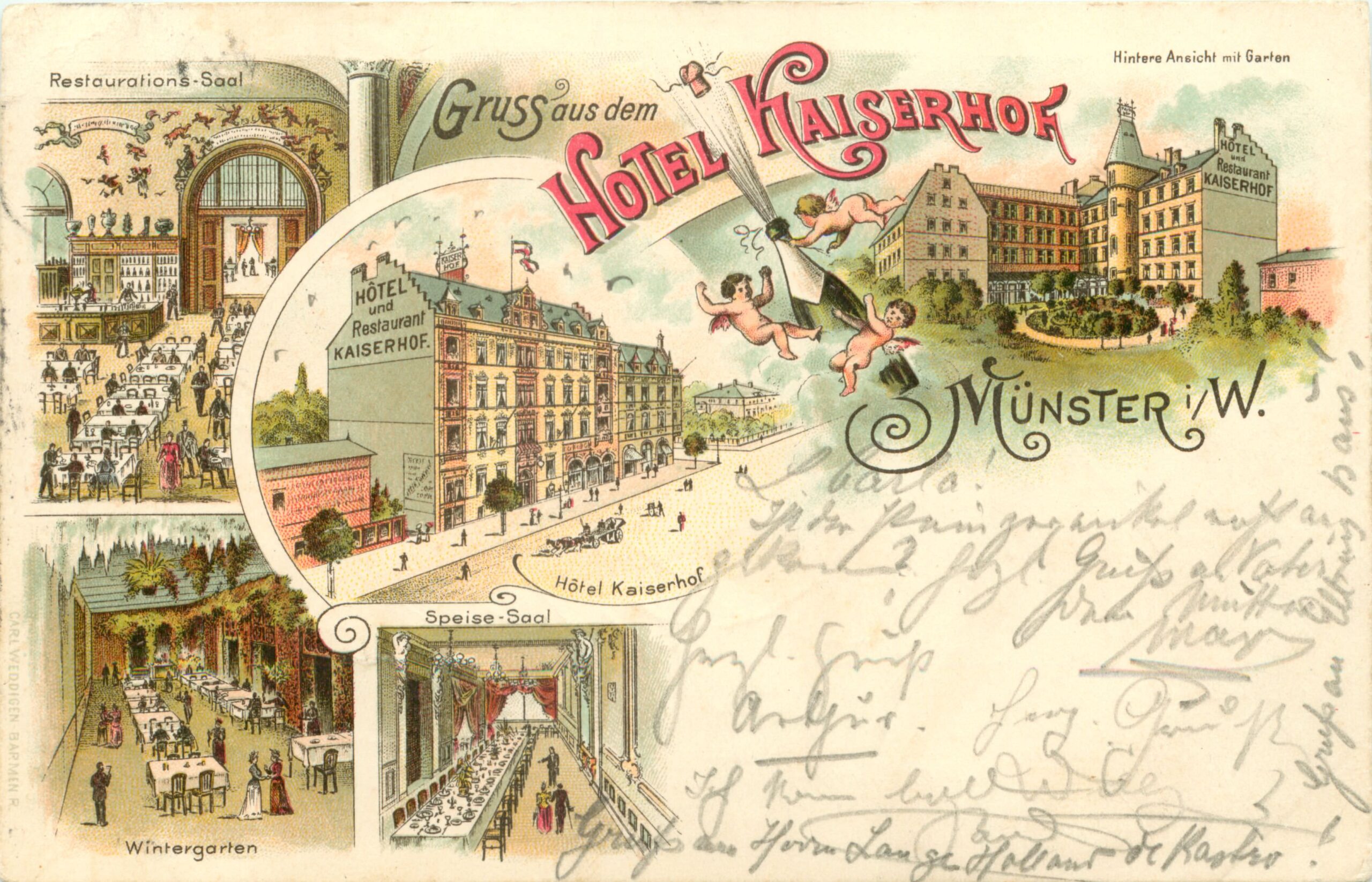
The Kaiserhof was built and opened in 1895 by Oskar Försterling. According to newspaper reports, Oskar Försterling was the tenant of the “Ludgerihof” hotel on Ludgeriplatz, where Stadthaus II is today. The Kaiserhof was located directly opposite the Central Station, which opened in 1890. It had five floors facing Bahnhofstrasse and a wing facing Achtermannstrasse, with a sixth floor housing the staff. It also included an outdoor and winter garden.
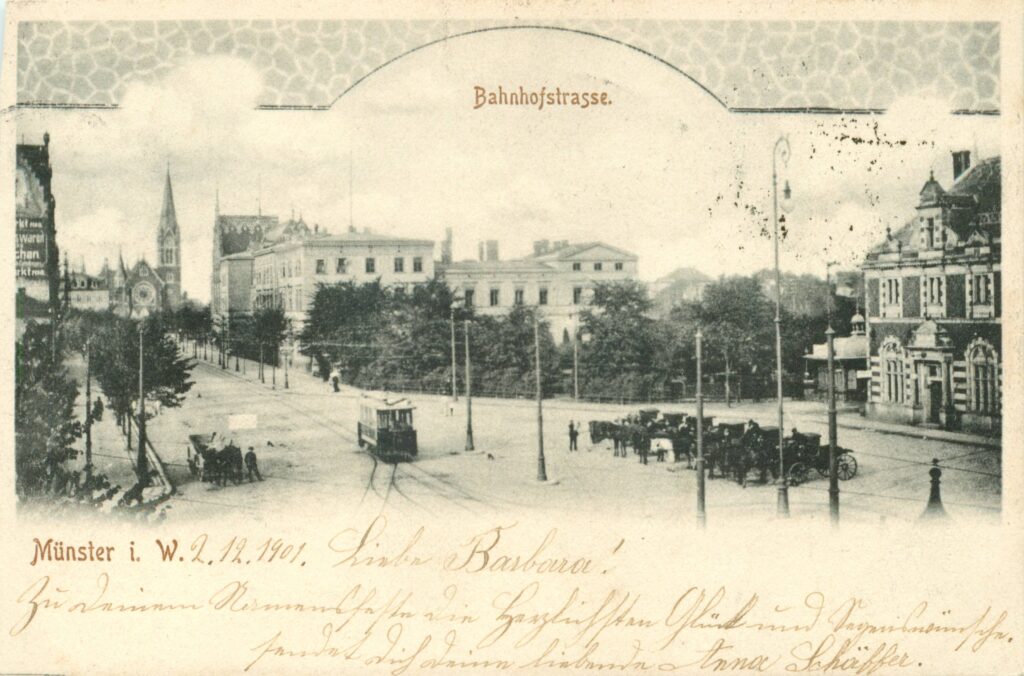
The location of the Kaiserhof was crucial for the hotel’s development. Münster grew rapidly throughout the 19th century. In 1815, the city was declared the provincial capital and developed into the center of Westphalia in the following decades. However, for a long time, the transport infrastructure was not as advanced as the city itself. The city received its first small train station in 1850. It wasn’t until 36 years later that work began on the inner-city transport network. A private horse-drawn bus line was established, which was replaced by a tram around 1901.
Due to the rapid growth of the rail network, the station quickly became too small. A new central station was built on the site of the current station, but its capacity was also exhausted shortly after the First World War. According to newspaper reports, 800 trains passed through the station daily. 9,000 passengers used it on weekdays, and up to 15,000 on Sundays. The station and Bahnhofstrasse had become of outstanding importance, which also explains why Bahnhofstrasse – the city’s most important street – was renamed Adolf Hitler Strasse by the Nazis in 1933 and became one of the most important targets for subsequent bombings.
The Kaiserhof had flourished in its early years – partly due to the development of the Bahnhofsviertel (station district) – and was recommended to travelers in the first Michelin Guide in 1910. But for reasons unknown to us, Oskar Försterling decided to sell it around 1930.
Sale to Josef Cremer
The hotel was purchased by Josef Cremer. Born in 1845, Josef Cremer had completed his Abitur (university entrance qualification) at the Paulinum in Münster. After school, he went on a study trip that took him to England, Belgium, and the Netherlands. Josef Cremer received his commercial training and gained his first professional experience in the iron and steel industry. At just 24 years old, he co-founded the “metallurgical export house” Willems & Cremer in Brussels. In March 1889, he purchased the Dortmund-based Brewery Thier & Co, founded in 1854, from his cousins. Sixteen years before his death on January 1, 1938, Josef Cremer was made an honorary citizen of the city of Dortmund for his decades of service, especially in the cultural sphere.
The Second World War as a Fateful Stroke
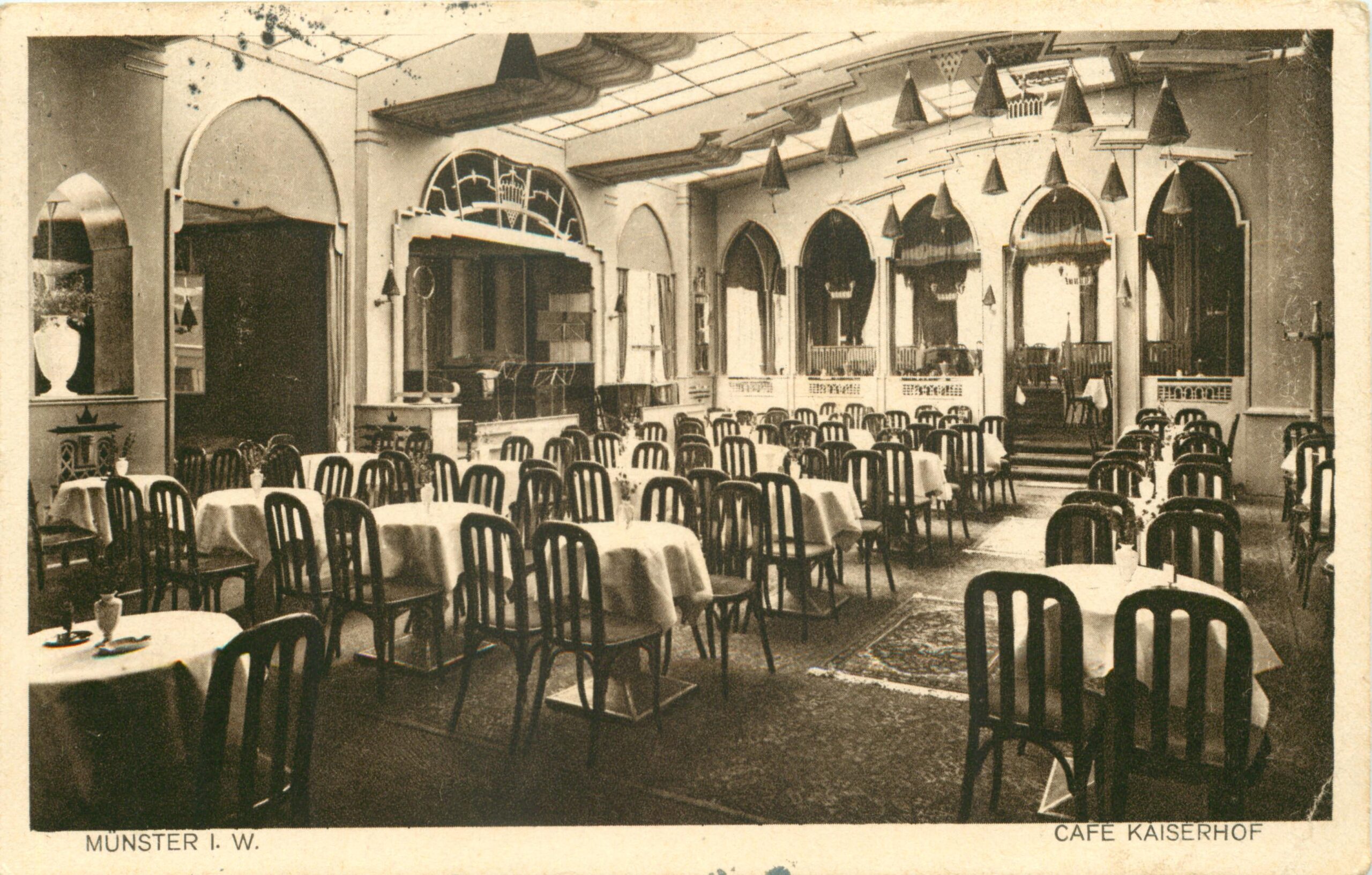
Josef Cremer did not want to manage the Kaiserhof himself, as he wanted to fulfill his obligations at the brewery. He leased the hotel to Konrad Teerling, the son-in-law of founder Oskar Försterling. He was primarily responsible for ensuring that the hotel became one of the most famous in Münster. The most popular café orchestras played in what was then known as the “Concert Café.” There was a large dance floor, and in the summer, the garden dance floor could also be used. A good dining option was the “Tunnel,” a traditional pub in the basement. The Tunnel was located in the hotel’s basement and was accessible via a staircase from Bahnhofstrasse.
On September 12, 1944, fate, or rather the bombs, struck hard. The Kaiserhof was almost completely destroyed. Only the “Tunnel” and part of its kitchen remained standing. The entire station district—a strategically important target for the bombs—was destroyed. From the Central Station, one now had an unobstructed view all the way to the city center.
From June 1945 until well into the 1950s, the Kaiserhof was slowly and painstakingly rebuilt. With the strong involvement of the tenant family and the Thier Brewery, five floors, a restaurant for hotel guests, and the café were gradually rebuilt. The garden and wings gave way to the now more modern architectural style and the demands of the guests.
The Missing Gifts from King Ibn Saud
After the war years, the Kaiserhof hosted a multitude of – sometimes illustrious – guests. Most memorable is King Ibn Saud, who visited the Kaiserhof twice – in 1964 and 1965. The then Saudi king rented an entire floor of the building for two weeks at a time. He reportedly came to Münster to receive treatment at the university hospital. The king always traveled with a large entourage and security personnel and gave very generous tips, for example, to the bellboy who drove up the limousine. He also gave the then tenant, Konrad Teerling, a saber with a gold handle and a gold dagger studded with precious stones. These gifts were long considered lost because they were sold by his son. Richard Koch, owner of the pawn shop of the same name on Bahnhofstrasse, had acquired them and hung them as decorations in his office. Years later, thanks to a newspaper report, he learned that these pieces were gifts from King Ibn Saud and, in 2002, “after brief and intensive negotiations,” handed them over to Kaiserhof owner Peter Cremer.
The Path to Today’s Modern Kaiserhof
In 1972, Oskar Teerling, Konrad Teerling’s son, took over the lease when he decided to enter his well-deserved retirement. In 1999, this lease expired, and Peter Cremer – Josef Cremer’s great-great-grandson – and his wife Anne became the first owners to take over the management of the hotel themselves. Under their leadership, renovation and modernization work began in 2001, lasting almost ten years.
Gradually, all rooms and bathrooms were renovated, windows with quadruple glazing were installed, conference rooms were rebuilt, and public areas such as the fireplace room and lobby were stylishly designed. In addition, air conditioning was installed in all rooms, event rooms, and public areas, and the exterior facade was modernized. The inventory was supplemented by select antiques and art objects – including original paintings by Busch, Haase, Determeyer, and Modersohn – from the private collection of the Cremer family.
The development of the building was also visible externally. A milestone was the opening of the “Kaisersaal” event space in 2006. Until a few months earlier, a drugstore had been located in the area of the building between the main entrance and the current restaurant. With the Kaisersaal, the old tradition of parties, balls, and, of course, modern conferences was revived – a bridge to the old imperial court. The foyer in front of the hall was used for exhibitions, among other things. A very special exhibition followed in March 2008, when the world’s oldest production motorcycle, an 1894 Hildebrandt & Wolfmüller, was on display in the foyer. According to newspaper reports, this honor was denied to the world-famous Guggenheim Museum in New York, which was actually very interested in the space.
Another milestone was achieved in 2008. The Cremer family purchased the neighboring building on the corner of Urbanstrasse and developed two restaurant concepts, which were realized in the new premises at the end of October. The two restaurants, Gabriel’s and Gourmet 1895, along with their wine cellars, opened that fall.
A lot also happened at the rear of the hotel in 2008. The parking lot was redesigned. In October, an 8 x 16 m artwork was attached to the wall of the adjacent building to the west, commemorating the “old” Münster and its famous figures, as the city of Münster did not approve of purely hotel advertising. The artwork by Hans Kröger depicts an idealized version of the Kaiserhof in its original state from 1895, enhanced with a few “witnesses to the city’s history.” It was based on an old postcard from the hotel’s founding years. He framed the front of the hotel with the gate pillars of the Erbdrostenhof. Afterwards, the scene was decorated with several figures from Münster’s past: Professor Landois returning from a morning drink, the great Bomberg riding past the hotel, and the emancipated sculptor Elisabet Ney driving her own car. According to tradition, Hans Kröger’s portrait was also placed in the window of a servant’s room. And, of course, Josef Cremer can also be seen.
Appreciated by guests, praised by travel guides
In spring 2011, the final phase of modernization was completed: the opening of the Kaiserhof Beauty & Spa, a 500 square meter wellness oasis on two levels. The years of effort were recognized by the DEHOGA (German Hotel and Restaurant Association) with the award of a four-star superior hotel. The restaurants received praise year after year from leading restaurant critics such as Gault Millau, Feinschmecker, and others. A special honor went to the Gourmet 1895 restaurant. In 2012, the restaurant was awarded a Michelin star for the first time and retained this distinction in subsequent years.
But even more important was and remains the appreciation of the services provided by international guests who report on their experiences at the Kaiserhof on travel portals such as HolidayCheck and Tripadvisor or on review sites such as Yelp. The entire team is delighted by the many compliments, high recommendation rates, and suggestions for improvement that help them continue to develop over time.
2013 – 2015
In 2013, Anne and Peter Cremer made the decision to gradually withdraw from operational business at the end of the year and hand over management of the hotel to younger hands. On January 1, 2014, Anja and Kay Fenneberg took over operational management of the Kaiserhof, and since January 1, 2015, they have been the hotel’s leaseholders.
Even in the first few years, Anja and Kay Fenneberg did much to maintain the hotel’s high standards and lead the hotel into the future. Two of the five floors were completely renovated. Individual rooms on the other floors have been updated, such as the family rooms, which received high-quality sofa beds. The exterior facade facing the parking lot, including the entrance, was extensively redesigned. The lobby, fireplace lounge, and bar were modernized, the seating in Gabriel’s Restaurant was replaced, and even the administrative offices were given a modern makeover. As part of the restructuring, the Gourmet 1895 Restaurant was closed in spring 2018. The hosts and kitchen staff are now concentrating on Gabriel’s Restaurant, the in-house celebrations and conferences, and the steadily growing catering business.
Through their dedication and significant investment, the Fenneberg family has not only created secure jobs for the 40 or so permanent employees and numerous temporary workers. They are also actively and diversely committed to recruiting and training young talent, who are often rewarded for their efforts by being among the best in their training year.
And another 10 years have passed
A look back – and forward
A lot has happened at the Kaiserhof in the last ten years: We have remodeled, modernized, and digitized – always with an eye on what is necessary and sensible.
Then came Corona – a time that was a difficult turning point for us too. The Kaiserhof was closed for a long time. A quiet, empty house. No laughter, no comings and goings. During this phase, we held onto our house and farm, gave away food, and tried to make the best of the situation.
When we were finally allowed to reopen, we were literally overwhelmed. Tourism in Germany has noticeably changed – many people are rediscovering travel within their own country. Our loyal regular guests have also returned. We are very pleased with this development – and with the fact that the Kaiserhof has never been empty since.
We are proud to be Münster’s only privately run hotel in the city center – and to remain so in the future.
Modern and digitally positioned, we remain true to what defines us: personal, attentive service and a warm atmosphere. Our fantastic team is passionate about what they do – day after day. And that’s exactly what our guests feel.
We’re looking forward to what’s to come!